Florida Governor Ron DeSantis proposed establishing a citizen Artificial Intelligence Bill of Rights to protect consumers.
Governor DeSantis also announced a proposal to protect Floridians from footing the bill for Hyperscale AI data centers and to empower local governments to reject their development in their communities.
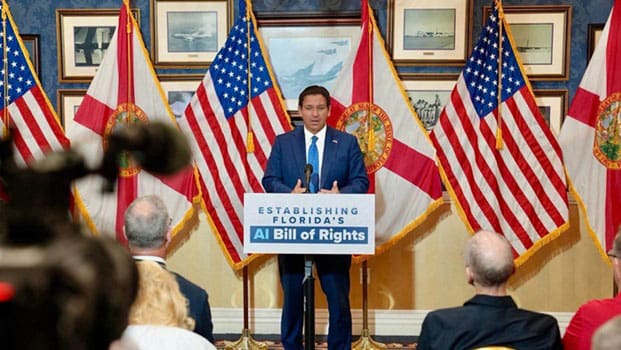 “I proposed new legislation on artificial intelligence and AI data centers to protect Floridians’ privacy, security, and quality of life,” said Republican Governor Ron DeSantis. “Our AI proposal will establish an Artificial Intelligence Bill of Rights to define and safeguard Floridians’ rights—including data privacy, parental controls, consumer protections, and restrictions on AI use of an individual’s name, image or likeness without consent.”
The Artificial Intelligence proposal will establish an AI Bill of Rights to provide consumers with protections including:
- Reenact protections Florida has already passed against “deep fakes” and explicit material, including those depicting minors.
- Prohibit any state or local government agency from utilizing DeepSeek or any other Chinese-created AI tools to protect American data.
- Prohibit AI from using an individual’s Name, Image, Likeness (NIL) without their consent – tie it to harm or sale of a product (political ads, schemes to defraud already in law).
- Require a notice to consumers when interacting with AI (Company chatbots).
- Prohibit entities from providing “licensed” therapy or mental health counseling through artificial intelligence. This can be expanded to include use of AI to imitate a licensed professional.
- Provide parental controls for minors which will allow parents to access the conversation their child has with a large language model, set parameters for when the child can access the platform, and notify parents if their child exhibits concerning behavior.
- Ensure data inputted to AI is secure and private.
- Prohibit companies from selling or sharing personal identifying information with third parties (deidentified) and mirror data privacy protections in current law.
- Limit insurance companies from using AI for insurance claims. Require that AI cannot be used as the sole determination in adjusting or denying a claim. Insurers that use AI for claims must detail the use and allow the Office of Insurance Regulation to inspect the AI model to ensure it does not violate unfair insurance trade practices.
The Data Centers proposal will protect consumers from footing the bill for AI data centers. According to the Florida Governor, the proposal will:
- Protect Ratepayers: Prohibit utilities from charging Florida residents more to support hyperscale data center development, including electric, gas, and water utilities.
- Protect Taxpayers: No taxpayer subsidies for Big Tech.
- Protect Local Control: Allows local government to prohibit data center construction/development.
- Protect Florida’s Water Resources: Ensure that water resources are not utilized to the detriment of the public.
- Protect Natural Florida: Prevent the construction, siting, or operation of a data center by foreign principals or on land classified as agricultural and/or lands under a greenbelt exemption, and require setbacks and vegetative buffers. Requires FDOT to complete noise abatement reviews to protect natural Florida from noise pollution.
President Donald Trump recently issued an executive order attempting to ensure a national policy framework for artificial intelligence. The President stated:
“To win, United States AI companies must be free to innovate without cumbersome regulation. But excessive State regulation thwarts this imperative. First, State-by-State regulation by definition creates a patchwork of 50 different regulatory regimes that makes compliance more challenging, particularly for start-ups. Second, State laws are increasingly responsible for requiring entities to embed ideological bias within models. For example, a new Colorado law banning “algorithmic discrimination” may even force AI models to produce false results in order to avoid a “differential treatment or impact” on protected groups. Third, State laws sometimes impermissibly regulate beyond State borders, impinging on interstate commerce.
“My Administration must act with the Congress to ensure that there is a minimally burdensome national standard — not 50 discordant State ones. The resulting framework must forbid State laws that conflict with the policy set forth in this order. That framework should also ensure that children are protected, censorship is prevented, copyrights are respected, and communities are safeguarded. A carefully crafted national framework can ensure that the United States wins the AI race, as we must.”