The USDA announced the commodity payment rates for the Farmer Bridge Assistance program with payments in February.
U.S. Secretary of Agriculture Brooke Rollins announced the next phase in the Farmer Bridge Assistance Program (FBA), the eligible commodity per-acre payment rates. As announced earlier by President Donald Trump and Secretary Rollins, $12 billion will be paid to American farmers in 2026. Of that amount, $11 billion consists of one-time FBA program payments.
 “President Trump committed to increase certainty in the farm economy, and farmers can count on these payment rate calculations when going to the bank as they plan for the spring planting season. Putting Farmers First means delivering real relief when it matters. Farmers who qualify for the FBA Program can expect payments in their bank accounts by February 28, 2026,” said Secretary Brooke Rollins. “These one-time payments give farmers the bridge to continue to feed and clothe America and the world while the Trump Administration continues opening new markets and strengthening the farm safety net. USDA is making this process as simple and seamless as possible so producers can focus on what they do best – feeding and fueling our nation.”
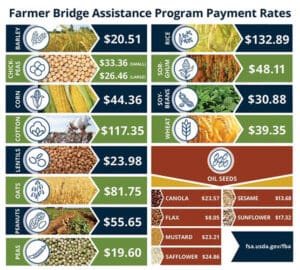
The commodity payment rates for the Farmer Bridge Assistance eligible commodities that triggered a payment (Commodity, Per Acre Payment Rates):
- Barley: $20.51
- Canola: $23.57
- Chickpeas (Large): $26.46
- Chickpeas (Small): $33.36
- Corn: $44.36
- Cotton: $117.35
- Flax: $8.05
- Lentils: $23.98
- Mustard: $23.21
- Oats: $81.75
- Peanuts: $55.65
- Peas: $19.60
- Rice: $132.89
- Safflower: $24.86
- Sesame: $13.68
- Sorghum: $48.11
- Soybeans: $30.88
- Sunflower: $17.32
- Wheat: $39.35
The Republican administration said this is in response to “four years of disastrous Biden administration policies that created record-high input and production costs, zero new trade deals, and a forgotten rural America.”
FBA payments are based on 2025 planted acres, Economic Research Service cost of production, and the World Agriculture Supply and Demand Estimate Report. Double crop acres, including all initial and subsequently planted crops, are eligible. Prevent plant acres are not eligible. All intended row crop uses are eligible for FBA except grazing, volunteer stands, experimental, green manure, crops left standing and abandoned or cover crops.
Crop insurance linkage is not required; however, USDA strongly urges producers to take advantage of the new risk management tools provided for in the One Big Beautiful Bill Act (OBBBA) to best protect against future price risk and volatility. The OBBBA federal crop insurance improvements include expanding benefits for beginning farmers and ranchers, increasing coverage options, and making crop insurance more affordable.
Of the $12 billion being provided by the Commodity Credit Corporation Charter Act, up to $11 billion is being directed to eligible row crop producers and the remaining $1 billion of the $12 billion in assistance is reserved for specialty crops and sugar. Timelines for payments to producers of these crops are still under development and require additional understanding of market impacts and economic needs.