Lockheed Martin’s newest GPS satellite successfully made it to orbit, strengthening warfighter connectivity.
The Space Force launched the Lockheed Martin-built Global Positioning System (GPS) III satellite, named in honor of NASA astronaut Col. Ellison Onizuka, into orbit on a SpaceX Falcon 9 rocket from Cape Canaveral Space Force Station in Central Florida. Lockheed Martin’s GPS III SV09 hosts new demonstration payload aimed at strengthening capabilities and constellation resilience.
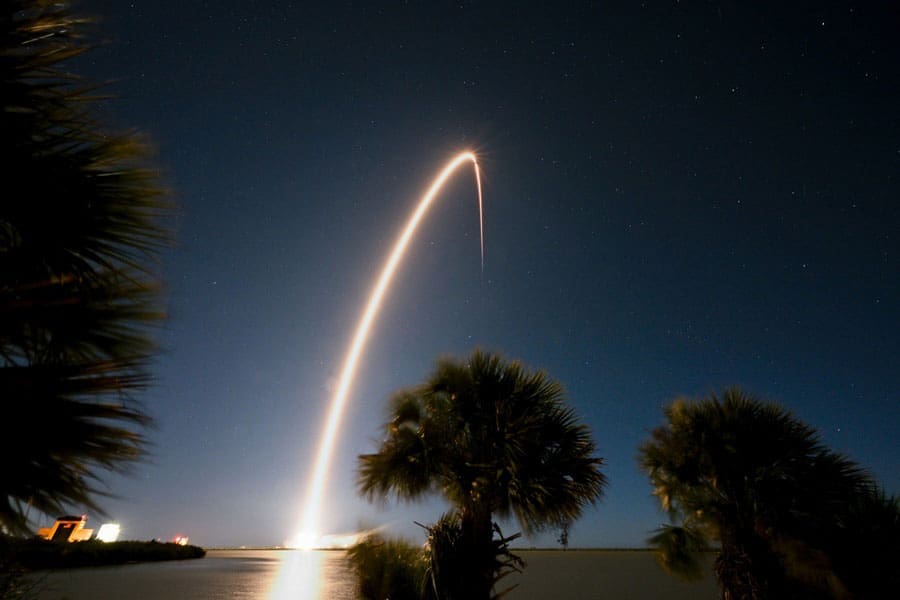 Last week, the company’s ninth GPS III space vehicle (SV09) launched in orbit, adding a capability that enables people to connect, gives warfighters the ability to operate in harsh conditions, and demonstrates the power of American innovation.
For the military, GPS III SV09 delivers advanced security and anti-jamming features, which brings uninterrupted, precise navigation and timing in contested or denied environments, safeguarding national-security and defense missions. Overall, GPS III satellites deliver three-times better accuracy, eight-times improved anti-jamming capabilities, and M-code navigation signals for warfighters globally.
Each additional GPS III satellite delivers increased accuracy with resilient signals that enable essential services such as aviation, precision agriculture, and telecommunications timing. Sustaining and expanding the GPS constellation is essential as the constellation ages. Adding new GPS spacecraft is required to maintain uninterrupted global coverage, and the forthcoming GPS IIIF satellites will deliver even greater capabilities.
In order to further strengthen GPS signal in the future, GPS III SV09 is also equipped with a laser retroreflector array, designed to improve measurements of the Earth’s orientation for the GPS coordinate system.
According to the Space Force, this GPS satellite is named in honor of Col. Ellison Onizuka, an accomplished U.S. Air Force flight test engineer, science and technology leader and astronaut from Kealakekua, Hawai’i who flew on the STS-51C space shuttle Discovery mission before perishing in the January 28, 1986, space shuttle Challenger disaster 40 years ago.
“The launch of GPS III SV09 is an important step in bolstering the resilience of the GPS constellation,” said Malik Musawwir, vice president of Navigation Systems at Lockheed Martin. “By adding more resilient satellites to the constellation, we’re laying the foundation for the GPS IIIF-era, which will provide 60-times more anti-jam capabilities. The ongoing investment in GPS III launches and additional GPS IIIF satellites ensures uninterrupted, precise navigation and timing for our forces, even in contested or denied environments.”
The satellite launched from Cape Canaveral Space Force Station on January 27th at 11:53pm ET aboard a SpaceX Falcon 9 rocket. It achieved signal acquisition shortly thereafter and is now under operational control at Lockheed Martin’s Denver Launch & Checkout Operations Center until its official acceptance into the GPS operational control network.
Lockheed Martin has completed production of GPS III SV01-SV10 satellites and is currently manufacturing next-generation GPS IIIF satellites.